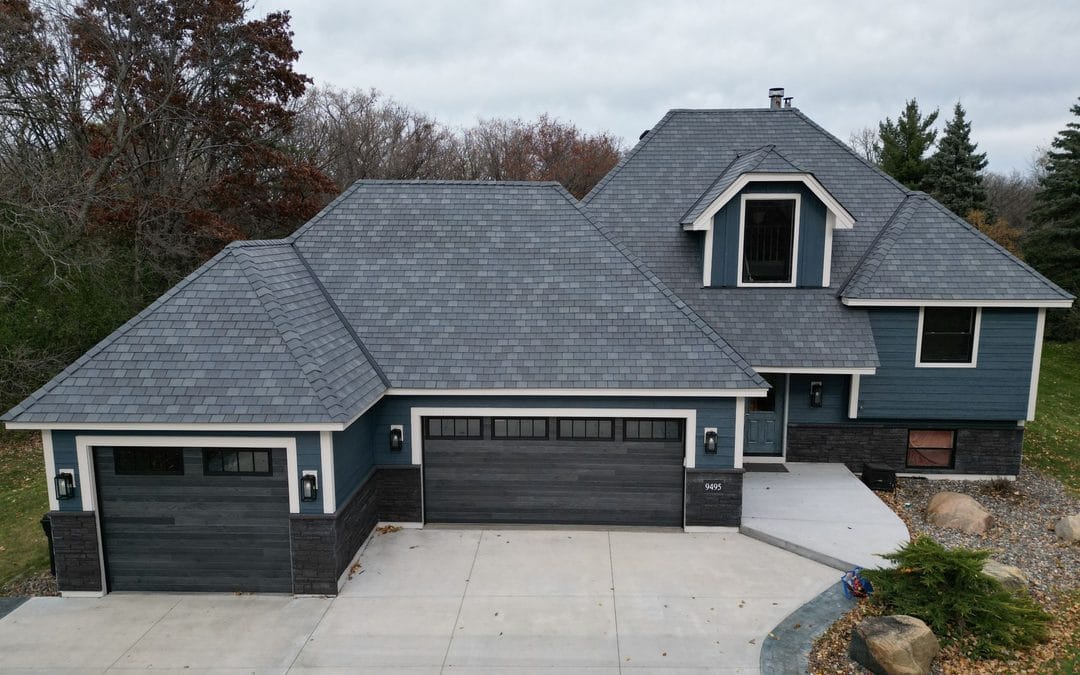
Diamond Kote siding in Woodbury, Minnesota
Diamond Kote Siding: Lasting Color, Architectural Detail, and a Better Minnesota Exterior
A premium siding system is more than the panel. It is the color, trim, transitions, weather protection, and installation discipline that make the entire home feel intentional.
 Certified Diamond Kote installer serving Woodbury and the Twin Cities metro
The short answer
Diamond Kote is a factory-applied finish system most commonly used on LP SmartSide engineered wood siding. It combines a durable engineered-wood substrate with a proprietary finish made with metal-oxide pigments. For Solid, DuoBlend Premium, and custom colors, Diamond Kote backs that finish with a 30-year no-fade limited warranty. The result is a low-maintenance exterior with rich color, realistic wood texture, and enough profile and trim options to design a genuinely custom facade.
For Minnesota homeowners, that combination is compelling. The siding must tolerate moisture, wind, temperature swings, hail exposure, and long winters. At the same time, the exterior should still look considered when viewed from the street, the driveway, or a few feet from the front door.
That is why Diamond Kote belongs in the premium conversation. It is not simply a color upgrade. It is a complete exterior palette with lap siding, board and batten, shake profiles, trim, corners, mounting blocks, and moisture-management components that can work together as one design.
It is a useful analogy because color is often what first attracts a homeowner to Diamond Kote. The technical reason is more precise: Diamond Kote says its finish uses metal-oxide colorants that resist the UV exposure responsible for rapid fading in many ordinary coatings. The written warranty defines “excessive fade” using a measurable color-change standard, and its terms, exclusions, maintenance requirements, and remedies matter. Homeowners should review the current warranty before selecting a collection.
Product, explained plainly
What Is Diamond Kote Siding?
Diamond Kote and LP SmartSide play different roles in the finished product. LP manufactures the engineered wood siding substrate. Diamond Kote, a brand of Wausau Supply Company, applies its proprietary factory finish and offers coordinated siding-system components.
LP SmartSide begins with wood strands. LP documents that those strands are combined with resin, wax, and zinc borate, formed under heat and pressure, and protected with a resin-saturated overlay. The zinc-borate-based SmartGuard process is designed to resist termites and fungal decay. The finished product retains the warmth and workable character of wood while being engineered for exterior exposure.
“Poly-infused” is a convenient shorthand, but the more accurate description is treated engineered wood with water-resistant resins, waxes, zinc borate, and a protective overlay. Diamond Kote then adds the factory-controlled color finish that gives the siding its distinctive appearance and fade coverage.

Why it reads as premium
Prestige Comes From the System, Not a Single Feature
Premium siding should still look premium after the novelty of a new color wears off. Diamond Kote earns attention because its performance story and design flexibility reinforce each other.
1. Color is part of the product, not a final jobsite step
The finish is factory applied under controlled conditions. That helps create consistent color and coverage across siding, trim, corners, and compatible accessories. It also avoids turning the entire house into a field-painting project immediately after installation.
2. The substrate has real wood character
Diamond Kote’s common LP SmartSide substrate can deliver deep cedar-grain texture and crisp profiles without asking a homeowner to maintain natural cedar. It is still an engineered wood product, so correct storage, cutting, clearances, flashing, fastening, and sealing remain essential.
3. Coordinated components reduce visual compromises
Utility blocks, vents, trim, corners, soffit and fascia areas can interrupt an otherwise beautiful elevation. A coordinated system gives the designer and installer a better chance to make those necessities feel integrated instead of added afterward.
4. The warranty addresses the concern homeowners notice first
When dark or saturated siding fades unevenly, it can change the entire character of a home. Diamond Kote’s 30-year no-fade limited warranty directly addresses excessive fading, chalking, yellowing, peeling, and blistering as defined in the written document. It is a strong differentiator, but it is not an unconditional promise that every color will remain visually identical forever. Product collection, ownership, maintenance, installation, claim timing, and warranty terms all matter.
Warranty note: Diamond Kote currently lists 30-year no-fade coverage for Solid, DuoBlend Premium, and custom colors, and 15-year no-fade coverage for the WoodMark Collection. Always review the warranty in effect when the product is purchased.

Design before ordering
Where Lap, Board and Batten, and Shake Belong
A luxury exterior does not need every available material. It needs a clear hierarchy. The primary siding carries the home; accents explain the architecture.
- Lap siding usually works best across the broad main wall planes. Its horizontal lines visually settle the home and provide continuity.
- Board and batten is strongest on tall gables, entry towers, dormers, or other vertical masses that deserve height and emphasis.
- Shake siding adds texture to smaller gables, porch peaks, and carefully selected focal areas. Used everywhere, it can dilute its impact.
- Transition bands should align with real architectural breaks such as floor lines, roof returns, porch roofs, or changes in wall depth.
- Trim width and color should be planned around window scale, corner conditions, roof overhangs, and the depth of the siding profile.
Before material is ordered, Sky Armor maps these decisions elevation by elevation. The goal is not to decorate the house. It is to make the architecture easier to read.
Front-elevation strategy
Pairing Diamond Kote With Versetta Stone or Real Stone
The front elevation carries most of a home’s curb appeal because it contains the entry, garage relationship, window rhythm, and the view people experience most often. Stone can add permanence and depth, but only when it supports those focal points.
Where stone usually has the most impact
- Around the main entry or porch columns, where texture can frame the arrival experience.
- On a chimney or projecting front bay that already has visual weight.
- As a restrained wainscot where there is a clean, intentional termination line.
- At a garage return or foundation condition when it visually balances the entry instead of competing with it.
Versetta Stone is a panelized, mortarless, fiber-reinforced concrete veneer. The manufacturer describes a mechanically fastened tongue-and-groove system with a built-in rainscreen and drainage provisions. That can make it a practical partner for a siding-led exterior when the selected profile, color, sill, corners, clearances, flashing, and water-resistive barrier are detailed as a complete assembly.
Real stone offers natural variation, mass, and depth that manufactured products cannot duplicate exactly. It can also introduce greater weight, structural considerations, masonry support, labor, and different transition details. A qualified designer, contractor, and, when appropriate, structural or masonry professional should verify the assembly.
The best choice is not automatically the most stone. Often, one concentrated area of well-detailed stone looks more luxurious than several disconnected patches. The siding color should pull from one of the stone’s quieter tones, while trim provides a controlled bridge between the two materials.
Real work, real decisions
A Sky Armor Diamond Kote Project
This Minnesota project shows why product selection and installation planning cannot be separated. Color establishes the first impression, but the finished quality comes from the relationship between siding exposure, gable accents, window trim, corners, rooflines, and transition points.
Sky Armor Exteriors is based in Woodbury and serves homeowners across the Twin Cities metro. As a certified Diamond Kote installer and an LP BuildSmart Preferred Contractor, the team approaches premium siding as a complete exterior system: existing-wall assessment, moisture management, flashing, product layout, architectural detailing, and final walkthrough.
See more completed exterior work in the Sky Armor project portfolio, or explore what defines luxury siding in Minnesota.
Projects are won in the details
What a Detail-Focused Diamond Kote Installer Plans
Diamond Kote can provide the ingredients for an exceptional exterior. The installer still determines how those ingredients come together. Homeowners should expect the project conversation to go well beyond “Which color do you like?”
- Existing wall conditions. A responsible scope considers the sheathing, water-resistive barrier, window and door openings, penetrations, and any signs of prior moisture trouble before new siding conceals them.
- Elevation-specific layout. Siding profiles, reveals, seams, corners, gables, band boards, and stone transitions should be drawn or clearly documented before installation.
- Water management. Flashing must direct water out and over the layers below it. Roof-to-wall intersections, windows, doors, decks, blocks, horizontal transitions, and stone interfaces deserve special attention.
- Manufacturer-required clearances and fastening. Engineered wood moves with moisture and temperature. Gaps, edge distances, nailing, penetration, and ground or roof clearances must follow the current product instructions and local requirements.
- Cut-edge treatment and touch-up discipline. Field cuts and minor finish damage need the specified protection. Touch-up products are for controlled repair, not for hiding careless handling.
- Trim and mounting blocks. Lights, outlets, faucets, vents, meters, and other penetrations need planned mounting surfaces and clean alignment. These small details become highly visible on a premium facade.
- Material transitions. Lap-to-board-and-batten, siding-to-stone, wall-to-roof, and siding-to-window connections should create clean shadow lines while continuing to drain correctly.
- Final specifications. Color, profile, exposure, trim sizes, accessory colors, stone locations, and change procedures should appear in the project scope so the home is built to the design discussed.
Ask a prospective installer to explain these conditions on your home. The strongest answer is specific: what they see, what they propose, which manufacturer detail applies, and how it will look when finished.
Minnesota performance
Why Installation Matters in a Freeze-Thaw Climate
Woodbury and the Twin Cities do not expose siding to one simple condition. A single year can bring wind-driven rain, humid summers, intense sun, hail, deep cold, snow accumulation, and repeated freeze-thaw cycles. No cladding makes water management optional.
LP’s engineered substrate is designed for moisture resistance, strength, and resistance to fungal decay and termites. Diamond Kote reports impact testing of its RigidStack lap siding with hail up to 1.75 inches and wind performance up to 200 mph in specified assemblies. Those are manufacturer performance claims, not a promise that every wall will be damage-proof. Product selection, wall design, fastening, exposure, building geometry, and installation all affect real-world results.
For a Minnesota home, the quiet details behind the siding are often the most important: a continuous water-resistive barrier, correctly lapped flashing, pan flashing at openings where required, kickout flashing at roof-to-wall intersections, planned drainage at stone transitions, and proper clearance from roofs, decks, paving, soil, and snow-prone surfaces. A local building official and the current manufacturer instructions should govern project-specific compliance.
Sky Armor’s Woodbury exterior team looks at roofing, wall, window, and flashing relationships together because exterior systems do not fail in isolated categories.
A clear comparison
Diamond Kote Compared With Other Siding Approaches
There is no universal best siding for every home. The right choice depends on design priorities, maintenance expectations, wall conditions, budget, and installer capability. This high-level comparison helps frame a consultation.
| Consideration | Diamond Kote on LP SmartSide | Field-painted engineered wood | Fiber cement | Premium vinyl |
|---|---|---|---|---|
| Finish | Factory-applied proprietary finish with collection-specific fade warranty | Depends on primer, paint system, site conditions, and painter | Factory-finished or field-painted options | Color is integral to the product |
| Appearance | Deep wood texture, rich colors, coordinated trim and accessories | Wood texture with broad paint-color flexibility | Painted wood-look or smooth profiles | Wide range; depth and texture vary by line |
| Design range | Lap, vertical, shake, nickel gap, trim, and accessory system | Varies by substrate and fabricator | Lap, panel, shingle, and trim options | Broad profile and color selection |
| Installation focus | Moisture management, clearances, cuts, touch-up, layout, and system accessories | Same, plus field-coating quality and timing | Handling, cutting, flashing, clearances, fastening, and dust controls | Expansion, fastening, panel movement, wind design, and transitions |
| Best fit | Homeowners prioritizing durable color, wood character, and custom architectural detailing | Projects needing a particular field-applied paint specification | Homeowners who prefer a cementitious cladding and its design language | Homeowners prioritizing low maintenance and a broad range of price points |
Use real product samples outdoors before making a final decision. Screen colors, print samples, shade, roof color, stone, landscaping, and the direction each wall faces can all change how a color reads.
Budgeting intelligently
What Influences the Cost of a Diamond Kote Project?
Diamond Kote is generally selected as a premium siding system, but a meaningful proposal cannot be reduced to one universal square-foot price. Two homes with similar floor plans can require very different scopes.
- Total wall area, number of stories, access, and roof or landscape protection
- Tear-off, disposal, sheathing repairs, and water-resistive barrier work
- Siding collection, profile, exposure, color, and RigidStack options
- Amount and complexity of board-and-batten, shake, nickel-gap, or custom accents
- Trim widths, corners, window and door surrounds, frieze, band boards, and mounting blocks
- Versetta Stone or real-stone areas, caps, corners, structure, flashing, and transitions
- Window, door, deck, roof-to-wall, electrical, mechanical, and other penetration details
- Permits, engineering or design services when needed, and project-specific code requirements
A useful estimate should make these decisions visible. Sky Armor provides an itemized scope so the homeowner can understand what is included, what remains optional, and which design choices are driving the investment.
Homeowner questions
Diamond Kote Siding FAQ
Is Diamond Kote the same as LP SmartSide?
No. LP SmartSide is the engineered wood siding substrate. Diamond Kote is a proprietary factory-applied finish and coordinated siding system offered by Wausau Supply Company, commonly on LP SmartSide products.
Does Diamond Kote really have a 30-year no-fade warranty?
Diamond Kote currently publishes a 30-year no-fade limited warranty for Solid, DuoBlend Premium, and custom colors. The WoodMark Collection currently carries 15-year no-fade coverage. “No fade” is defined by the written warranty, including a measurable threshold for excessive fade, and the warranty contains eligibility requirements, exclusions, and specific remedies. Review the current document before purchase.
Is Diamond Kote siding hail-proof?
No siding should be described as hail-proof. Diamond Kote reports testing of certain products against hail up to 1.75 inches, and its RigidStack system is marketed for high strength. Storm angle, hail size, wind speed, substrate, product selection, and installation can affect damage. Have suspected storm damage inspected in person.
Can Diamond Kote use board and batten and shake on the same house?
Yes, and the result can be excellent when each profile follows the architecture. A common approach is lap siding on primary walls, board and batten on taller gables or vertical masses, and shake on one or two smaller focal gables. Restraint and transition placement matter.
Can Diamond Kote be paired with Versetta Stone?
Yes. Versetta Stone is a mechanically fastened, panelized manufactured-stone veneer that can work well in a mixed-cladding design. The wall assembly still needs coordinated flashing, drainage, clearances, sills, corners, and water-resistive barrier details at every transition.
How do I choose a Diamond Kote installer in Minnesota?
Ask about current manufacturer credentials, product-specific training, moisture-management details, cut-edge treatment, clearances, fastening, trim and mounting blocks, warranty documentation, and who makes design decisions in the field. Request a written, elevation-specific scope and examples of completed siding work.
How much maintenance does Diamond Kote need?
Diamond Kote is positioned as a low-maintenance siding system, not a no-maintenance one. Follow the current care guide, keep gutters and drainage functioning, clean dirt or organic buildup using approved methods, and inspect caulking, flashing, penetrations, and damaged areas periodically. Avoid cleaning methods the manufacturer does not approve.
Does a siding consultation include color and exterior design?
With Sky Armor, the conversation can include profile placement, color relationships, trim width, stone accents, shadow lines, roof and window coordination, and the installation scope behind those design decisions. Final recommendations depend on the home’s architecture and existing conditions.
This article provides general product and design information, not an engineering assessment, code determination, warranty interpretation, or diagnosis of a specific home. Current manufacturer instructions, warranty documents, local officials, and qualified professionals should govern the project.
Woodbury and the Twin Cities
Design the elevation before the siding goes on it.
Talk through color, profile placement, trim, stone, water management, and installation details with Sky Armor Exteriors.