
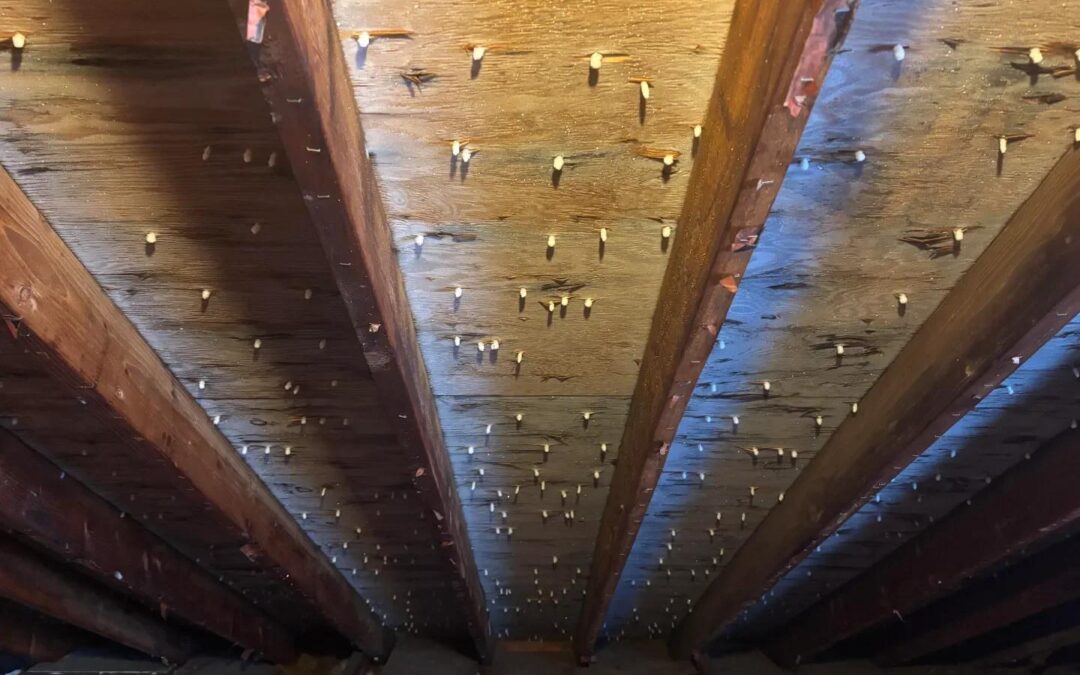
Short answer: A ceiling can drip during a Minnesota thaw even when it has not rained. The water may come from melting attic frost caused by indoor moisture, snowmelt backing up behind an ice dam, or a defect in roofing or flashing. Because these problems can look alike—and can occur together—a roof-and-attic inspection should identify the moisture path before anyone recommends repair or replacement.

Why do Minnesota winter thaws reveal moisture problems?
A cold spell can store up a problem that becomes visible only when temperatures rise. Warm indoor air contains moisture from ordinary activities such as cooking, bathing, humidifiers, and breathing. When that air escapes through ceiling penetrations, plumbing and wiring openings, attic hatches, or other gaps, it can reach cold roof sheathing and framing. Water vapor may then condense or freeze as frost.
During a thaw, attic frost can melt. The resulting water may drip onto insulation, follow framing, or appear as a ceiling stain some distance from where the moisture first formed. That is one reason a roof may appear to be leaking without rain.

A thaw can also melt snow on the roof. If the roof surface is warmer higher up but remains below freezing near the eaves, meltwater can refreeze at the edge and form an ice dam. Water held behind that dam may move beneath the roof covering through available gaps and reach the attic, walls, or ceiling. The University of Minnesota Extension explains how heat loss, snow cover, and uneven roof temperatures create this cycle.

A separate roofing defect remains possible. Damaged shingles, failed flashing, deteriorated sealants, an open penetration, or a previous repair can admit water during rain or snowmelt. Timing is useful evidence, but it is not a diagnosis: a home may have air leakage and an exterior roof defect at the same time.
Is it a roof leak, an ice dam, or attic condensation?
Start with the weather, the location, and the pattern of moisture. These clues help narrow the investigation, but none can prove the cause by itself.
| Possible cause | Typical timing or conditions | Clues a homeowner may notice | What a professional needs to inspect |
|---|---|---|---|
| Roofing or flashing leak | Often follows rain, wind-driven precipitation, or snowmelt; may recur at the same location. | Staining near a chimney, wall, valley, skylight, vent, or other penetration; damaged roofing visible from the ground. | Roof covering, flashings, penetrations, valleys, transitions, previous repairs, underlayment context, and the interior water path. |
| Ice dam backup | Snow is on the roof; freeze-thaw conditions occur; ice may build near eaves or gutters. | Water near exterior walls or eaves, icicles or ice buildup, and symptoms that track snowmelt. Ice may be present without an interior leak. | Roof temperature pattern, eaves and drainage, evidence of backed-up water, heat-loss pathways, insulation, air sealing, and roof details. |
| Attic frost or condensation | Cold weather follows periods of elevated indoor moisture; dripping becomes visible as attic temperatures rise. | Frost or droplets on accessible attic surfaces, widespread dampness, wet nail tips, compressed or damp insulation, or moisture not tied to rainfall. | Moisture distribution, indoor-to-attic air leakage clues, bath and kitchen exhaust routing, insulation, soffit pathways, and exhaust ventilation. |
Why might adding ridge vent fail to stop attic moisture?
Ventilation is only one part of the roof-and-attic system. A ridge vent provides an exhaust opening near the roof peak, but it does not seal the paths carrying warm, moist indoor air into the attic. It also cannot work as intended without clear, appropriately distributed intake ventilation—commonly at the soffits—and an unobstructed path between intake and exhaust.
A sound recommendation follows the findings. The sequence often involves controlling moisture at its source, verifying that bathroom and kitchen exhaust ducts terminate outdoors rather than in the attic, sealing accessible air-leakage paths, correcting insulation gaps or compression, and then evaluating whether the intake and exhaust ventilation are suitable for the roof design. Work around combustion appliances and major air sealing may require an energy or building-performance professional who can assess pressure and safety.
Simply cutting in more exhaust vent can leave the moisture source unchanged. In some conditions, powered attic fans may even create unwanted pressure differences and draw more indoor air into the attic. University of Minnesota Extension does not recommend mechanical attic ventilation as a general Minnesota ice-dam solution. The goal is not “more vent” in isolation; it is a controlled air boundary, appropriate insulation, correctly routed exhaust, and a functioning ventilation path.
What does wet or stained roof decking actually tell you?
Wet decking confirms that moisture is present; it does not identify the source or automatically mean the roof needs replacement. The location and pattern can guide the investigation. A concentrated trail below a penetration may suggest exterior water entry, while widespread frost or moisture across cold sheathing may point toward indoor air and moisture movement. But patterns can overlap, and water can travel along framing before it becomes visible.
Dark staining alone does not prove active moisture, mold, rot, or structural failure. An inspector should consider whether the material is currently wet, whether it is soft or delaminated, whether fasteners still hold, whether there is visible deterioration, and whether the source has been corrected. Moisture measurements or material evaluation may be appropriate, depending on access and conditions.
Decking replacement is a condition-based decision. Localized material that has lost structural integrity may need replacement; sound material with historic staining may not. Suspected microbial growth, extensive deterioration, or structural movement should be evaluated by a qualified mold, indoor-environmental, engineering, or building professional as the situation requires. Painting over a suspect area is not a substitute for stopping the moisture and completing an appropriate evaluation.
What should a roof-and-attic evaluation check?
A useful evaluation connects exterior roof details with interior moisture patterns. Sky Armor’s existing guide to what a professional roof inspection should examine includes roofing condition, flashing, ventilation, ice-and-water protection, drainage, and accessible attic observations. For a winter ceiling drip, the investigation should consider:
- Shingles or other roof covering near the suspected water path, including damage, displacement, wear, and previous repairs.
- Flashing at chimneys, sidewalls, headwalls, valleys, skylights, plumbing vents, and other penetrations.
- Evidence consistent with ice dam backup near eaves, roof transitions, and exterior walls.
- Whether attic moisture is localized or widespread, and whether frost, droplets, wet fasteners, or damp insulation are present.
- Accessible gaps around attic hatches, lights, plumbing stacks, wiring, top plates, and other ceiling penetrations.
- Whether bath, kitchen, and dryer exhaust ducts terminate outdoors and appear connected, insulated, and intact where visible.
- Insulation depth and distribution, including gaps, compression, wind washing, and blocked soffit pathways.
- Intake and exhaust ventilation locations, clear air paths, and signs that multiple vent types may be interfering with intended airflow.
- Decking condition, moisture pattern, softness, delamination, fastener condition, and visible deterioration.
- Interior stain location, active dripping, recent weather, indoor humidity clues, and any plumbing sources that also need to be ruled out.
A roof-and-attic visual inspection may identify a likely source and needed exterior repairs. It is not the same as diagnostic testing. Blower-door testing, infrared imaging under suitable conditions, pressure diagnostics, indoor-air assessment, laboratory sampling, or structural analysis may require an energy auditor or other qualified specialist. The University of Minnesota’s moisture-control guidance emphasizes identifying and controlling the moisture source, including sealing openings that allow warm, moist air into ceilings and attics.
When should you request an inspection?
Request an inspection when a ceiling stain grows, dripping recurs, insulation or decking appears wet from a safe vantage point, ice buildup accompanies interior moisture, or the timing does not clearly match a plumbing event. Prompt documentation is especially useful because frost, ice, and wet surfaces can change quickly with the weather.
While waiting, protect the interior from active dripping if you can do so safely and avoid disturbing electrical fixtures. Do not climb a snowy or icy roof. Do not enter an attic with unsafe access, inadequate walking surfaces, exposed wiring, suspected structural damage, or heavy frost and moisture. Take photos only from stable, accessible locations.
When contacting a contractor, note the date and time, outdoor temperature trend, recent snow or rain, where the water appeared, and whether it followed a thaw. These details help separate a roof leaking without rain from attic frost melting, an ice dam, plumbing, or another source.
Frequently asked questions about winter ceiling leaks
Why is my ceiling leaking when it has not rained?
Melting attic frost, snowmelt backed up by an ice dam, a plumbing source, or meltwater entering through a roofing or flashing defect can all produce a drip without rainfall. The timing and moisture pattern are clues, but an inspection must trace the source.
Can attic frost melt and look like a roof leak?
Yes. Warm, moist indoor air can leak into a cold attic and freeze on roof sheathing, framing, or fasteners. When conditions warm, that frost can melt and wet insulation or ceilings, closely resembling an exterior leak.
How can an ice dam differ from attic condensation?
An ice dam holds roof snowmelt behind ice near a cold eave, allowing water to move under the roof covering. Attic condensation begins with indoor moisture reaching cold attic surfaces. Both are influenced by heat and air leakage, both may appear during a thaw, and both can occur together.
Will adding ridge vent stop attic condensation?
Not necessarily. Ridge vent cannot seal indoor air leaks, correct a bath fan exhausting into the attic, restore missing insulation, or create intake airflow through blocked soffits. The entire air-sealing, insulation, exhaust, intake, and ventilation system needs to be evaluated.
Does wet roof decking mean I need a new roof?
No. Wetness shows that moisture is present, not why it is present or whether the decking has lost structural capacity. The source, extent, material condition, roof covering, and flashing details determine whether drying, targeted repair, decking replacement, or broader roof work is appropriate.
Can a new roof alone fix attic condensation?
Not if indoor air leakage or moisture sources remain. A roof project may create access to correct damaged materials or ventilation details, but condensation control may also require air sealing, insulation work, and properly routed exhaust ducts.
What photos or details should I send a contractor?
Send safely taken photos of the ceiling stain or drip, the surrounding room, any visible eave ice from the ground, and accessible attic conditions only if entry is safe. Include when the symptom began and whether it followed rain, snowfall, snowmelt, or a temperature swing.
Sources: Building-science explanations in this article are supported by University of Minnesota Extension guidance on ice dams and home moisture control. Individual homes require inspection; this article is educational and does not diagnose a specific property.